
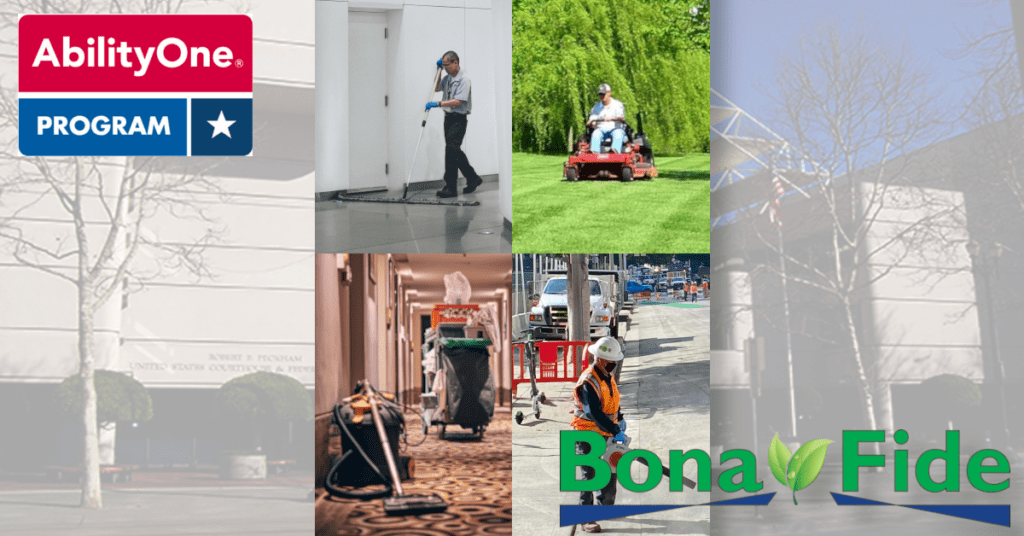
What is the AbilityOne Program?
(Updated June, 2025)
The AbilityOne Program is a federal program that employs individuals with severe disabilities. This program creates jobs and sells fair market products to Government agencies. It does this by working with participating independent nonprofit organizations. AbilityOne began as the Javits-Wagner-O’Day Act, a federal law passed in 1971. This law requires all Federal agencies to purchase specified supplies and services from organizations employing persons who are blind or have other significant disabilities.
AbilityOne plays an important role in federal procurement. It accounts for more than $4 billion per year in sales. And it enlists 405 nonprofit agencies across the country. The program operates at more than 1,000 locations, representing 40 government agencies, in all 50 states, including Guam and Puerto Rico.
Through the program, federal customers receive quality products and services, while people with significant disabilities receive quality jobs, a competitive wage, and opportunities for career advancement. This benefits the government and the community, by providing high-quality goods and services, and residents with work and purpose.
What is the AbilityOne Commission?
The program is overseen by the AbilityOne Commission. This is an independent federal agency made up of 15 presidentially appointed members. The Commission works with federal agencies and authorized distributors to ensure program compliance.
The AbilityOne Commission also oversees a procurement list to determine which products and services can be obtained by federal government buyers through the AbilityOne program. The Commission is also responsible for setting fair market prices for goods and services.
AbilityOne Provides Meaningful Employment
The most important part of the AbilityOne program is that it creates opportunities for people that are often overlooked. It provides employment and training opportunities for approximately 39,000 people who are blind or have significant disabilities, including 2,500 veterans.
Through the program, people with severe disabilities receive ongoing training and employment. This is because nonprofit agencies must use a ratio of 75% direct labor employees who have significant disabilities. This is important because the unemployment rate for people with a disability was about twice that of those with no disability in 2024. To make matters worse, a large proportion of people with a disability- about 75 percent- were not in the labor force at all in 2024. This means that many uncounted people have simply given up looking for work.
Thus, the AbilityOne program is disability advocacy at its best. Quality federal jobs are set aside for people that might otherwise be discriminated against- or never given an opportunity. People with disabilities are given the chance to display that they can contribute, and they are provided training, accommodations, and opportunities for advancement.
Bona Fide Conglomerate and the AbilityOne program
Bona Fide is proud to be a nonprofit agency in the AbilityOne program. We are dedicated to contributing to the training and employment of people with severe disabilities. Bona Fide provides Total Facility Management services for many state and federal properties. And over 75% of the labor is done by employees with significant disabilities or veterans.
Thanks to the AbilityOne program, we at Bona Fide are privileged to play a part in such a meaningful advocacy program. “It is very rewarding to be able to help someone with a disability learn, grow and become financially stable.” – Linda Trembley, Project Manager for Bona Fide in Tampa, Florida.
“Their job is a source of pride for them, knowing they are working just like anyone else – that makes them feel empowered.” -Tina Tyko, Project Manger, Santa Rosa.
Providing employment for people with disabilities is a positive example of the Federal government working for the people. Federal agencies that participate in the program support disability advocacy and social responsibility. And it can be a lifesaver for people living with severe disabilities.